
Business
Amazon and Shopify Bookkeeping: Finding Your True Profit Margin
Why marketplace deposits are not revenue, how to reconcile Amazon and Shopify settlements, cost inventory at landed cost and read margin by SKU and channel.
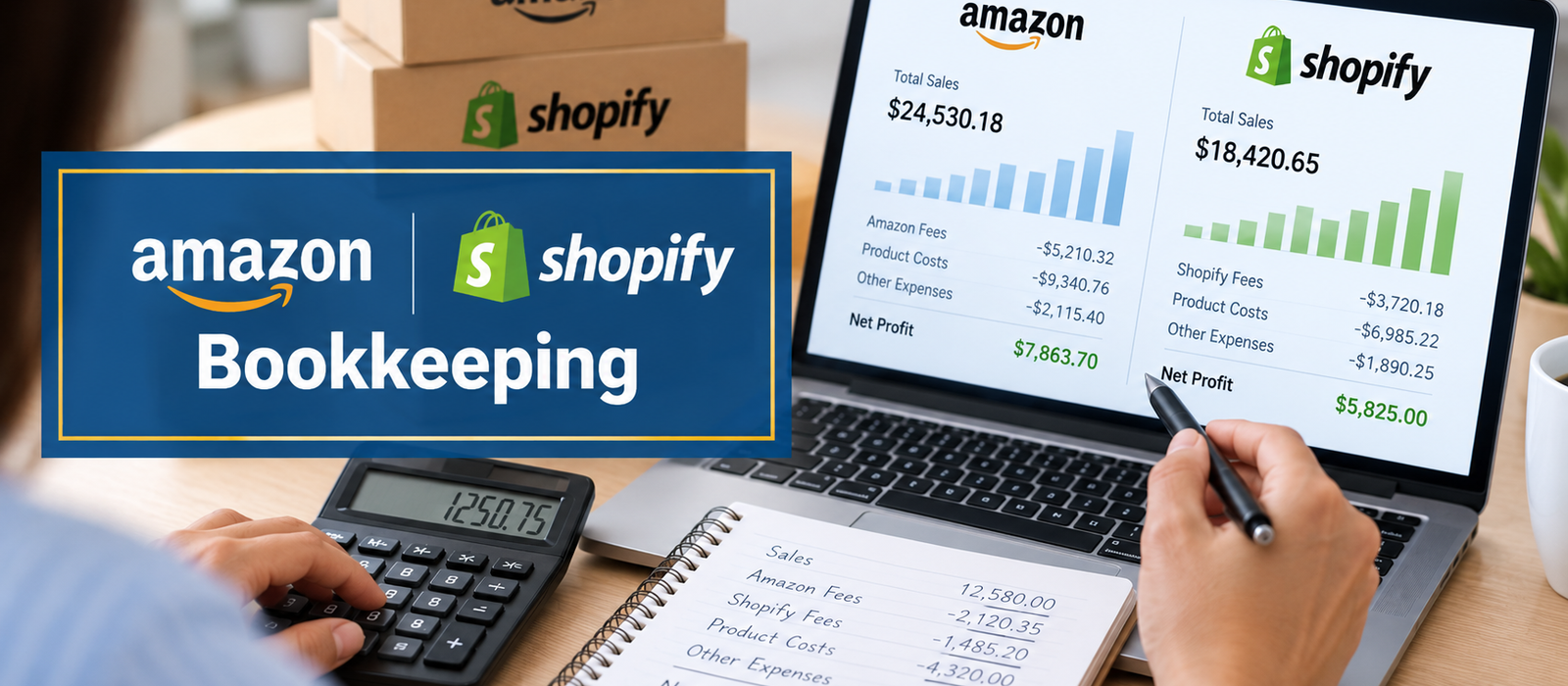
The money Amazon or Shopify sends to your bank is not your revenue. It is what is left after refunds, discounts, platform commissions, processing fees, shipping adjustments, advertising charges and sometimes a reserve have been taken out. Book that deposit as “sales” and three things disappear from your profit and loss statement: your true gross sales, your fee expense and your refund rate. This guide shows how to reconcile marketplace settlements properly, cost inventory at its real landed cost and read margin by product and channel.
How much difference it makes
Take a composite example, not a client: an online brand doing about $4.2 million a year on Shopify plus a few Amazon FBA products. When its books moved from recording deposits as sales to recording full settlement detail, reported gross margin shifted by roughly nine points. One product line that looked healthy turned out to be losing money. Your own swing will differ, but the direction is common.
One settlement, two ways
| Line | Amount |
|---|---|
| Gross sales in the period | $100,000 |
| Refunds and discounts | ($8,000) |
| Commission, processing and fulfillment fees | ($10,000) |
| Shipping labels and adjustments | ($2,000) |
| Bank deposit | $80,000 |
Recording only the $80,000 understates revenue by $20,000, shows no fee expense and hides $8,000 of refunds that may come from one or two problem products. Recording each line separately lands on the same $80,000 of cash with everything visible.
Alongside this, inventory leaves the balance sheet as units ship and becomes cost of goods sold. Gross profit is net sales less COGS, never the deposit less COGS.
What sits inside an Amazon settlement
Amazon settles roughly every two weeks. Each report mixes product revenue, shipping and gift wrap charged to buyers, collected tax, cash refunds and fees such as referral commissions and FBA fulfillment charges. A cash refund is not the same event as a physical return, which your inventory records must track separately. Two features complicate things further:
- Reserves. Amazon may hold back part of a settlement and release it later. Record the sale when it happened and carry the held amount as a receivable until it arrives.
- Cross-period items. Late refunds or fee corrections for earlier orders appear in later reports. Left alone, they cause small, recurring variances.
Policies change, so confirm reserve and fee details in your Seller Central account.
How Shopify payouts work
Shopify Payments or a connected processor batches orders and pays out the net, often daily or every few days, after processing fees, refunds and chargebacks. App subscriptions or other charges run through the same account must be split out rather than counted as sales. Because each channel settles on its own schedule, a multi-channel bank feed is really several interleaved streams, and each must be reconciled on its own.
Use a clearing account for each channel
The standard fix is a clearing account on the balance sheet for every channel. Gross sales, refunds and fees post to it from settlement detail; the bank deposit is matched against the balance. Any difference is a specific item to explain, such as a reserve, a timing lag or a missing fee, instead of a mystery inside sales. Tools like A2X automate this by turning settlement reports into summarized journal entries.
| Settlement item | Where it goes |
|---|---|
| Product sales | Revenue: gross sales |
| Shipping charged to buyers | Revenue: shipping income |
| Cash refunds | Contra-revenue: refunds and allowances |
| Referral or marketplace commission | Operating expense: marketplace fees |
| Payment processing | Operating expense: processing fees |
| FBA fulfillment fees | Fulfillment expense or COGS, by consistent policy |
| Ads billed through the platform | Operating expense: advertising |
| Reserve held or released | Balance sheet: marketplace receivable |
| Chargebacks | Contra-revenue or bad debt, by policy |
| Net deposit | Cash, clearing the channel account |
Whether fulfillment fees belong in COGS is a policy choice. Pick one with your CPA and apply it everywhere so channels compare fairly.
Cost inventory at landed cost
COGS should cover what it took to get the units you sold ready to sell: product cost, inbound freight, duties and related packaging. Marketing, platform fees and general warehousing are operating expenses. A $20 product with $2 of freight, $1 of duty and $1 of prep handling really costs $24, which is 20% more than the vendor invoice. Using the invoice price alone overstates margin most on imported, freight-heavy items, the very products where pricing decisions matter most.
Track by SKU and by location
A catalog-wide average cost hides slow, expensive products behind fast, cheap ones. Cost each SKU individually, and keep one inventory total that includes FBA warehouses, third-party logistics providers, your own space, goods in transit and returns awaiting inspection. Units you cannot see on a shelf are still your asset.
The small business inventory exception
For tax purposes, a business that passes the Section 448(c) gross receipts test (average annual receipts over the prior three years at or under the threshold) can use Section 471(c) to treat inventory as non-incidental materials and supplies or follow its book method, instead of the full inventory rules. The threshold was $31 million for 2025 and is $32 million for 2026 under Revenue Procedure 2025-32. The same test governs the cash method and the exemption from the UNICAP rules. Three cautions: related entities under common control are generally aggregated, switching methods may require Form 3115, and the 2027 figure should be checked when published. This is a decision to make with a CPA.
Even a business using a simplified tax method should keep full landed cost and SKU reporting in its management books. The tax method measures income for the IRS; management accounting tells you whether you are actually making money.
A cleaner profit and loss layout
Order the statement as: gross sales, less refunds and discounts, equals net sales; less landed COGS, equals gross profit; less marketplace and processing fees, fulfillment (if not in COGS), advertising and other expenses, equals operating income. Fees and ads sit below gross profit so each margin means something.
Gross margin versus contribution margin
Gross margin shows product economics. Contribution margin also subtracts the variable cost of selling each unit: fees, processing and a fair share of advertising. A product sold through FBA may show a strong gross margin but a weaker contribution margin once fees are counted, while the same product shipped from your own stock through Shopify may reverse that order. Use contribution margin by channel and SKU for pricing and channel decisions.
A monthly close for online sellers
- Download full settlement reports for every channel.
- Tie gross sales to each channel’s own dashboard.
- Post sales, refunds, fees and shipping separately to each clearing account.
- Match clearing balances to bank deposits and explain gaps.
- Update landed cost for new pricing, freight or duty.
- Record COGS for units shipped at current SKU cost.
- Reconcile inventory across every location to one total.
- True up Amazon reserves held and released.
- Check cross-period settlement items.
- Reconcile platform ad spend to ad reports.
- Review margins by channel and top SKUs.
- Close the month and prepare management statements.
Mistakes we fix most often
- Recording the deposit as total sales
- Netting fees against revenue instead of expensing them
- Costing at vendor price or a blended average
- Leaving FBA and 3PL stock off the books
- No clearing account and no reserve tracking
- One margin figure across very different fee structures
- Assuming last year’s gross receipts threshold or testing one entity alone
- Reconstructing the whole year at tax time
Quick self-check
Do your books show gross sales, refunds and fees separately for every channel? Is inventory costed by SKU at landed cost? Does stock at FBA and your 3PL appear as an asset? Do you know contribution margin by channel? Do you close monthly? Each “no” is a place your reported margin may differ from your real one.
How CPA Torrance helps online sellers
We rebuild settlement reconciliation, landed cost tracking and channel reporting for Amazon and Shopify brands through our e-commerce accounting service and monthly bookkeeping, then use the clean numbers for tax planning, filing and CFO-level decisions. Book a 15-minute call for a margin and COGS review.
Frequently asked questions
Why does my Shopify deposit not match my sales?
The deposit is net of refunds, fees, chargebacks and timing items. Reconcile the full payout report to see the gap.
What is the difference between gross sales and the net deposit?
Gross sales is the order value before deductions; the deposit is what remains. Only gross sales belongs on the revenue line.
Are Amazon FBA fees part of COGS?
It is a policy choice. Many sellers treat fulfillment as close to COGS and referral fees and ads as operating expenses. Choose one approach and apply it consistently.
What is landed cost?
The vendor price plus freight, duties and handling needed to make a unit sellable.
What is the Section 471(c) threshold for 2026?
$32 million in average annual gross receipts, tested across related entities. Confirm eligibility with a CPA before changing methods.

This article is general information, not tax advice for your situation. Deadlines and rules can change; confirm with a tax professional before acting.