Tax Planning Strategies
CPA vs Enrolled Agent vs Tax Preparer: Which One Do You Need?
CPAs, enrolled agents and California CTEC preparers differ in who licenses them, what they must keep up, and how far they can represent you with the IRS. Here is how to choose and verify.
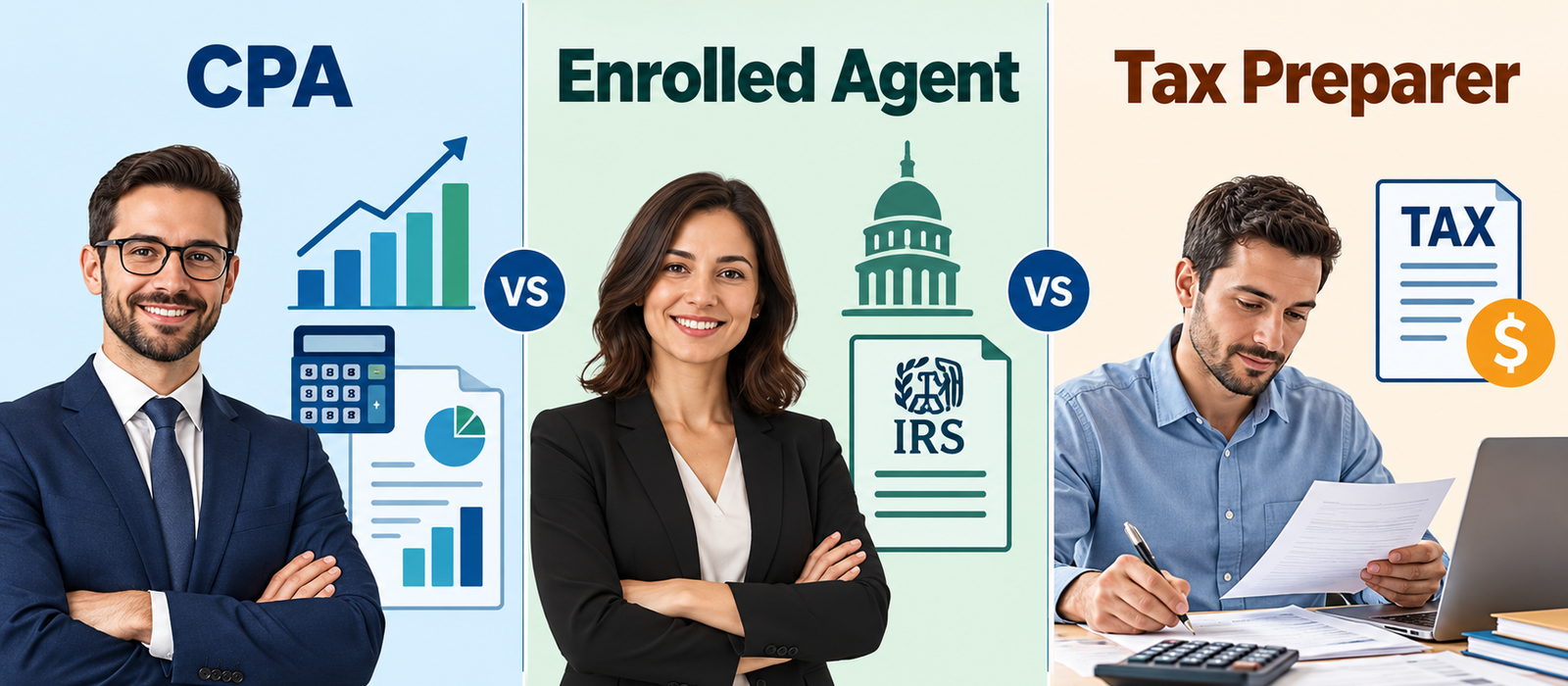
If you are deciding who should handle your taxes, the title on the business card matters less than two questions: what is this person legally allowed to do for you, and have they done it before for someone like you? A CPA, an enrolled agent (EA) and a California CTEC-registered preparer can all prepare a return for pay. Only the first two, along with attorneys, can stand in for you on any IRS matter.
This guide explains where each credential comes from, what it takes to earn and keep it, how far each one lets a professional go with the IRS, and how to check someone’s status yourself in a few minutes.
The short version
| Credential | Who grants it | How it is earned | Ongoing education | IRS representation |
|---|---|---|---|---|
| CPA | A state board of accountancy (the CBA in California) | Education, work experience and the Uniform CPA Examination | 80 hours every two years in California; other states differ | Unlimited |
| Enrolled agent | The IRS | A three-part IRS exam, or qualifying past IRS employment | 72 hours every three years, at least 16 each year | Unlimited |
| CTEC registered preparer | California Tax Education Council registration | A 60-hour qualifying course (or experience in lieu), bond and background check | 20 hours every year | None from registration alone |
| Attorney | A state bar | Bar admission | 25 hours every three years in California | Unlimited |
Rules change, so treat the table as a starting point and confirm details with the official sources linked below. A higher number of education hours does not by itself mean a better professional; the cycles are measured differently and experience counts for more.
CPAs: state licensed, broad scope
A Certified Public Accountant holds a license issued by a state board of accountancy, not by the IRS. Each state writes its own requirements. In California, the California Board of Accountancy expects a bachelor’s degree with 150 semester units in total, including set accounting, business and ethics coursework, 12 months of general accounting experience and a passing score on the Uniform CPA Examination. Signing attest reports takes 500 additional attest hours. The CBA has also announced a new licensure pathway starting January 1, 2027, so the rules that applied to a given CPA depend on when they were licensed.
To keep an active California license, a CPA completes 80 hours of continuing education in each two-year renewal period, with a minimum of 20 hours per year and required ethics and technical hours.
In practice, CPAs prepare returns, plan ahead for tax outcomes, produce financial statements and advise businesses. That does not mean every CPA does all of it. Some never touch audits, bookkeeping or personal financial planning, and industry experience varies widely, so ask what a particular CPA actually handles.
Enrolled agents: federal tax specialists
The IRS calls the enrolled agent designation the highest credential it awards. EAs focus on federal tax and earn the right to represent taxpayers before the IRS. The credential is federal, so it is not a substitute for a state CPA license.
Most EAs qualify by passing all three parts of the Special Enrollment Examination, which the IRS FAQ lists as Individuals, Businesses, and Representation, Practices and Procedures. Some former IRS employees qualify through their technical experience instead. Either way, the IRS enrollment process also requires a PTIN, an application and a suitability check that looks at the applicant’s own tax compliance and criminal background.
Enrollment generally renews every three years, with 72 hours of continuing education per cycle, including 6 ethics hours, and at least 16 hours (2 of them ethics) in each year. EAs handle both individual and business returns, and specialties differ from one EA to the next.
CTEC registered preparers in California
California requires most people who prepare returns for a fee to register with the California Tax Education Council, a nonprofit that oversees preparer education. Registrants are known as CTEC Registered Tax Preparers (CRTPs). According to CTEC’s own Q&A, California CPAs, enrolled agents and attorneys are generally exempt, which is why many paid preparers in the state never register with CTEC.
New registrants complete a 60-hour qualifying course (43 hours federal, 15 hours California and 2 hours ethics) or qualify through experience, buy a $5,000 surety bond, obtain a PTIN and pass a Live Scan background check, per CTEC’s registration requirements. They renew by October 31 each year with 20 hours of continuing education.
A PTIN is not a credential
Every paid federal preparer needs a Preparer Tax Identification Number, and so does every EA. The number identifies the preparer. It says nothing about licensing or training.
Preparing a return is not the same as representing you
The IRS Office of Professional Responsibility draws a clear line: preparing returns, even for pay, is not practice before the IRS. Practice means presenting your case on your rights or liabilities, and it is governed by Treasury Department Circular 230.
Based on IRS Publication 947 and the IRS guide to preparer credentials, the picture looks like this:
- CPAs, enrolled agents and attorneys can represent you on any matter, including audits, collections and appeals.
- Preparers in the voluntary Annual Filing Season Program can represent only clients whose returns they prepared and signed, and only before revenue agents, customer service staff and similar IRS employees, including the Taxpayer Advocate Service. Appeals and collections are out of scope.
- Preparers with a PTIN but no credential and no AFSP record cannot represent clients for returns prepared after 2015.
- You can always represent yourself.
A credential only helps while it is current. A lapsed CPA license, inactive bar status or late EA renewal suspends practice rights until it is fixed. State tax agencies and courts set their own representation rules, so ask separately about state matters.
Matching the professional to the job
Simple W-2 return
A competent preparer may be all you need. Consider a CPA or EA once investments, multiple states, business income or advisory needs enter the picture.
Self-employed or small business owner
Entity choice, estimated payments, depreciation, owner pay and recordkeeping all affect the result, so look for a CPA or EA with business tax experience. If you also need books kept or financial statements prepared, confirm the CPA offers those services. Our guide to choosing a small business CPA covers what a typical engagement includes.
Income in several states
Ask for specific experience with the states involved. Track record matters more than which credential the person holds.
You received an IRS notice
Read the notice type and response deadline first, then confirm the professional can represent you for that kind of matter. Collections disputes and litigation may call for a specialist or a tax attorney.
You need accounting, not just a return
Bookkeeping, financial statements and advisory work are separate services. CPA Torrance lists its bookkeeping services and financial systems and advisory work separately for that reason.
Check credentials yourself
- CPA: search the CBA License Lookup for status, expiration date and any discipline.
- Enrolled agent: the IRS verification page explains how to request confirmation through the Office of Enrollment, with a target reply time of 72 hours. The Directory of Federal Tax Return Preparers also lists credentialed preparers and AFSP participants.
- CTEC preparer: use CTEC’s Verify a Tax Preparer tool (California registrations only).
- Attorney: search the State Bar of California Attorney Search.
- PTIN: ask for it if relevant, remembering it proves identification only.
Verifying the credential and verifying the service scope are two separate checks. Do both.
Questions worth asking before you hire
- Which credentials do you hold right now, and where can I verify them?
- Do you work with businesses or households like mine?
- Who prepares my return, and who reviews it?
- Is planning during the year part of the service?
- Who handles an IRS or state letter, and is that billed separately?
- What does the engagement letter include, and how is extra work priced?
How CPA Torrance fits in
CPA Torrance is led by California-licensed CPAs and works with growing businesses on tax filing and compliance, tax planning, bookkeeping and financial advisory work. Not every reader needs a CPA, and the right fit depends on the work involved. If you want to know what an engagement would cover, book a 15-minute call or read more about the firm.
Frequently asked questions
What is the main difference between a CPA and an enrolled agent?
A CPA is licensed by a state board of accountancy and may also offer accounting and financial reporting. An enrolled agent is credentialed by the IRS and concentrates on federal tax. Both have unlimited IRS practice rights.
Is an enrolled agent the same as someone with a PTIN?
No. Anyone paid to prepare federal returns needs a PTIN. An EA has also passed the IRS Special Enrollment Examination or qualified through IRS experience, and can represent clients on any IRS matter.
What is a CTEC registered tax preparer?
A paid California preparer who completed the required education, bond and background check and registered with the California Tax Education Council. CPAs, EAs and attorneys are generally exempt from registering.
Who can represent me before the IRS?
CPAs, enrolled agents and attorneys have unlimited rights. AFSP participants have limited rights for returns they prepared, and you can always represent yourself. Check that the person’s status is current.
How do I check whether a California CPA is licensed?
Search the California Board of Accountancy License Lookup, which shows license status and any discipline or restrictions.

This article is general information, not tax advice for your situation. Deadlines and rules can change; confirm with a tax professional before acting.