Tax Planning Strategies
What Does a CPA Charge for Tax Prep in California? 7 Cost Drivers
CPA tax preparation fees in California depend on the work, not the form. Here are the seven cost drivers, what national fee surveys show, and how to compare quotes.
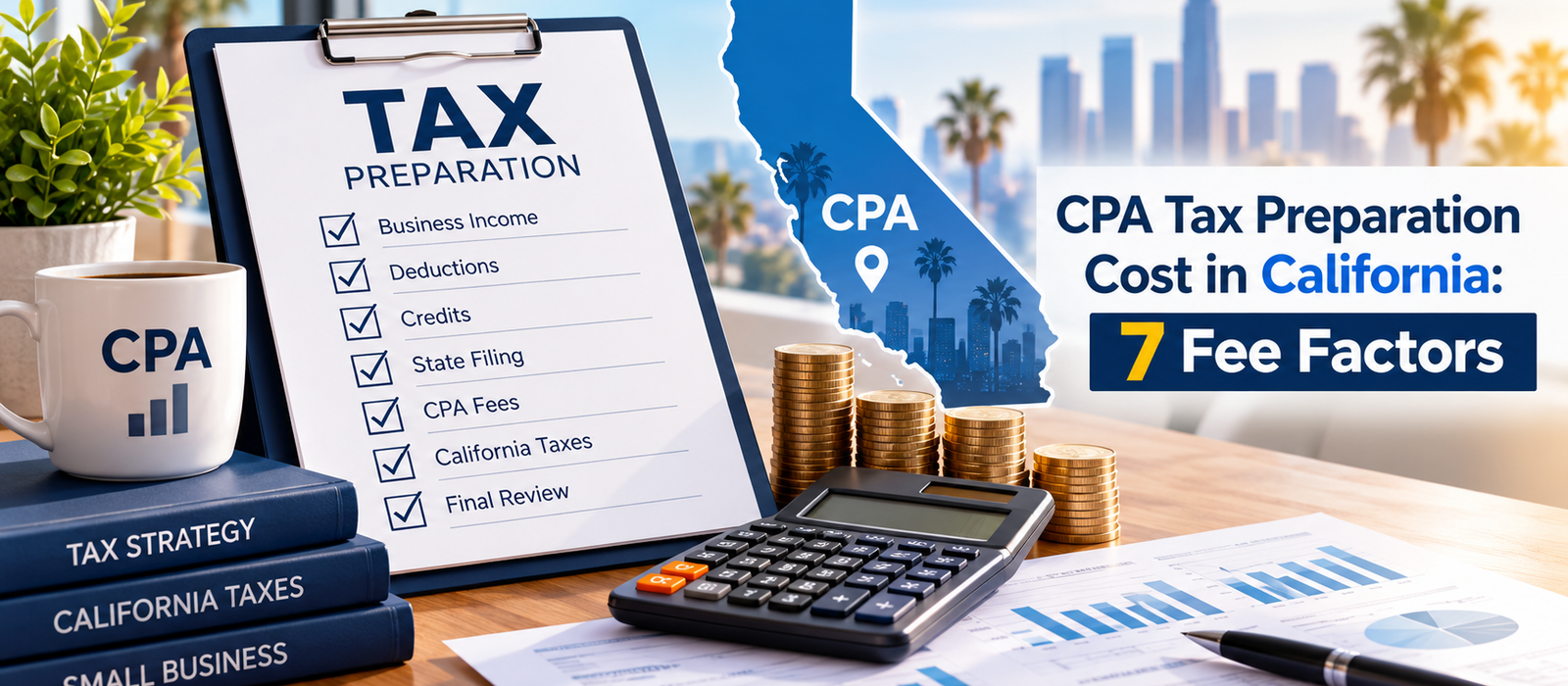
Ask five California CPAs what they charge to prepare a business return and you will hear five different answers, all of them honest. The fee is set by the work behind the return: how many returns and states are involved, how clean the books are, how many K-1s flow through, and whether you want planning or just filing. This article walks through those cost drivers, shows the only published fee surveys worth looking at, and explains how to compare quotes fairly.
Why one number never fits
Picture two owners who both file Form 1120-S. The first has one bank account, reconciled books and no out-of-state activity. The second has three owners, rental property in a separate LLC, equipment to depreciate, a prior-year error to correct and an open letter from the Franchise Tax Board. Same form, very different workload.
A CPA’s fee pays for review, research, judgment and responsibility for the result, not only data entry. It also rarely covers everything a business needs during the year. Bookkeeping, planning meetings and notice work are often scoped separately, which is why the scope of a proposal matters as much as its price.
Seven things that move the fee
| Cost driver | Lighter workload | Heavier workload | What it adds |
|---|---|---|---|
| Type of return | Individual return with W-2 income | Business return with several owners and fixed assets | Schedules, entity accounting and review time |
| States | One state | Activity, residents or income in several states | More state returns and sourcing work |
| Entities | A single company | Operating, property and holding companies | Extra returns and reconciliations |
| Condition of the books | Reconciled, with a clean balance sheet | Unreconciled accounts and gaps | Cleanup before preparation can start |
| K-1s | One simple K-1 | Several K-1s with basis or passive loss questions | Basis tracking and limitation work |
| Planning | Filing only | Projections, entity review, elections | Advisory time beyond the return |
| Open issues | Current year only | Amended returns, unfiled years, agency letters | Research, correspondence and follow-up |
1. The kind of return
Business returns (Form 1120-S, 1065 or 1120) usually involve balance sheets, depreciation, owner reporting and allocations. That said, a dormant company with tidy books can take less time than a complicated personal return.
2. How many states are involved
Nonresident filings, residency changes and multi-state sales each add analysis, and some states charge entity taxes or fees on top of income tax. Selling online does not automatically create a filing in every state, so a good CPA looks at your real connections to each state first.
3. How many entities you own
Each company can bring its own records and returns. Classification matters, though: a single-member LLC is generally disregarded for federal purposes, and California follows that treatment, even though California fees can still apply.
4. The state of your bookkeeping
Reconciled records let preparation start right away. Messy books mean bank and card reconciliations, recategorizing transactions, tying out loans and payroll, building a fixed asset schedule and cleaning up the balance sheet. That is accounting work, and it is often quoted as its own project.
5. K-1s and supporting schedules
Income from partnerships, S corporations and trusts flows to the owner’s return through K-1s. Basis calculations, at-risk and passive activity rules and late or amended K-1s all add time.
6. Planning on top of filing
A return reports last year. Planning looks ahead: estimated tax projections, entity and owner pay analysis, retirement contributions, depreciation elections and timing of big purchases. It may be part of a broader engagement or priced on its own, and it never guarantees a lower tax bill.
7. Old problems and tight deadlines
Unfiled years, amended returns, IRS or FTB notices and missing history all sit outside a standard preparation fee. Rush requests may affect price or scheduling at some firms, so ask.
What you can and cannot control
Your entity setup, states and K-1 count are part of your situation. What you control is how ready your books are, how complete your documents are on day one, how early you mention known issues and how much lead time you give. Clean books are one of the biggest levers on preparation effort, even though they cannot promise a lower quote.
How the main business forms differ
| Return | Core work | Things that add complexity | Ask the CPA |
|---|---|---|---|
| Form 1040 (individual) | Income, deductions, credits and the state return | Rentals, investments, K-1s, self-employment, several states | Which schedules and state returns are covered? |
| Form 1120-S (S corporation) | Financial statements, shareholder K-1s | Distributions, reasonable salary, depreciation, state filings | Are payroll review and shareholder returns included? |
| Form 1065 (partnership) | Allocations, capital accounts, partner K-1s | Agreement terms, contributions, special allocations | Who maintains the capital accounts? |
| Form 1120 (C corporation) | Corporate taxable income and state returns | Corporate accounting and state issues | Are estimated payments and state returns included? |
An S corporation files Form 1120-S for each year its election is in effect, and a partnership files Form 1065 with a K-1 for every partner. In California, S corporations file Form 100S, and LLCs follow their federal classification. Choosing an entity is a separate legal and tax decision outside this article.
Getting your records ready
A file that is ready for preparation usually contains:
- Reconciled bank and credit card accounts for the business
- A profit and loss statement and balance sheet that agree with the bank
- Payroll reports and loan statements
- Fixed asset purchases and disposals
- Owner contributions and distributions
- Last year’s return, K-1s and information returns
- Records of estimated tax payments
- Notes on anything unusual during the year
If your books need work before tax season, our monthly bookkeeping service keeps them reconciled all year so preparation starts from clean numbers.
Fixed fee or hourly?
Fixed scope gives you a known price and defined deliverables. Ask exactly which returns are included, what is excluded (cleanup, amended returns, notices) and which assumptions would trigger a change.
Hourly billing suits work whose size is hard to predict. Ask for the rates, an estimate or budget, and how you will be told if the job grows.
Always compare proposals line by line. Suppose one quote covers a single federal business return while another covers the business return, the owner’s personal return, state filings and a planning meeting. The second may cost more because it is a bigger job, not because it is a worse deal.
What the published fee surveys say
No survey publishes California-specific fees for business returns. Two national professional association studies do report business return figures from their members. Treat them as context, not as prices.
| Return | NSA 2020 study, national average | NSA 2024 report, average range |
|---|---|---|
| Form 1120-S | $903 | Not reported |
| Form 1065 | $733 | Not reported |
| Form 1120 | $913 | $750 to $1,250 |
| Form 1040 with itemized deductions | $323 | $300 to $600 |
The 2020 averages come from the National Society of Accountants Income and Fees study, based on 1,009 usable member responses (44% enrolled agents and 28% CPAs). The ranges come from the NSA 2024 Profit and Practice Report summary, which had 183 participants and does not say whether its averages are means or medians.
Keep three cautions in mind. The 2020 numbers are several years old, and the same NSA data shows the Form 1120-S average rising from $656 in 2007 to $903 in 2020. The National Association of Tax Professionals reports that most preparers raise fees every one to two years, usually by 6% to 10%. And neither survey shows what each practice included, so a multi-owner, multi-state company with messy books can land far above these averages.
How CPA Torrance builds a quote
- Discovery call to learn about the business, entity type and filing needs.
- Scope review covering returns, states, entities, book condition and open issues.
- Written proposal listing what is included, what is not and the fee.
- Engagement letter and a document checklist.
- Preparation and CPA review of the agreed work.
- Delivery, with any follow-up items flagged for separate scoping.
Owners who want help during the year as well can pair filing with tax planning or fractional CFO support.
What to send when you ask for a quote
Have your prior federal and California returns, entity and ownership details, the states involved, current financial statements, the status of your books, the number of K-1s, any open notices and your target completion date. A quote can change if the real records differ from the description, so share known problems early. You can confirm any California CPA’s license on the CBA License Lookup.
Ready for a written scope? Book a 15-minute call or see our tax filing and compliance service. No price or turnaround is promised before we review your records.
Frequently asked questions
How much does a CPA charge for tax preparation in California?
There is no standard fee. Return type, states, entities, bookkeeping quality and the written scope set the price, so a reliable figure comes only from a proposal based on your records.
What is the average cost of a business return?
National NSA data from 2020 put Form 1120-S, 1065 and 1120 averages between about $730 and $915, but those figures are dated, not California-specific and do not show what each firm included.
Does a business return always cost more than a personal return?
Usually, because of entity accounting, depreciation and owner reporting, but complexity drives the work rather than the form alone.
Is bookkeeping cleanup included in the preparation fee?
Not automatically. Cleanup is accounting work that is often scoped as its own project, so confirm it in writing.
Are state returns included?
That depends on the proposal. State obligations vary with residency, income and business activity, so ask which state filings are covered.

This article is general information, not tax advice for your situation. Deadlines and rules can change; confirm with a tax professional before acting.